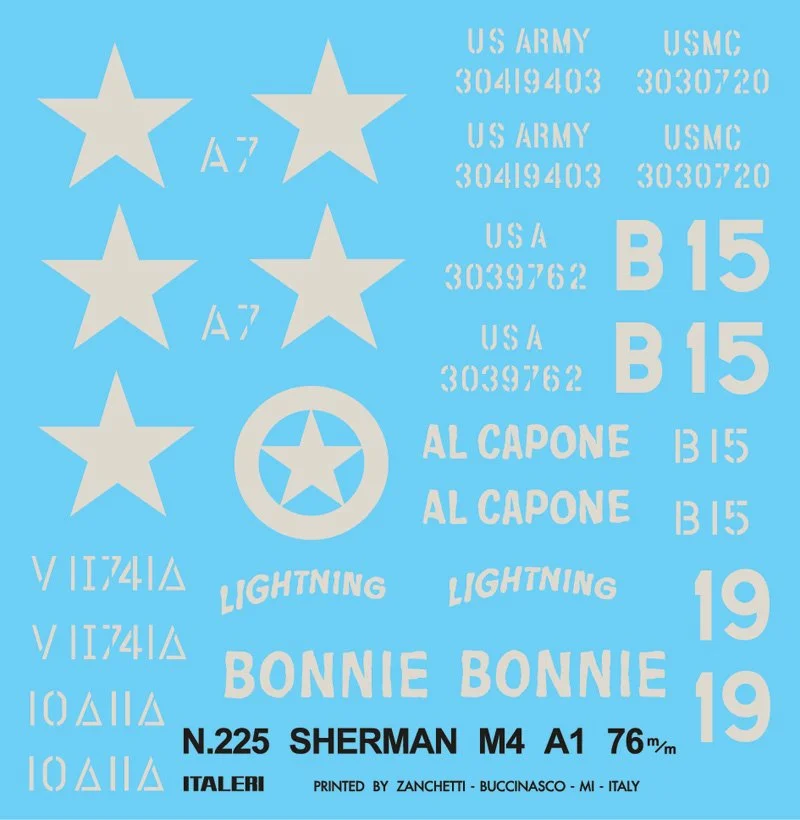
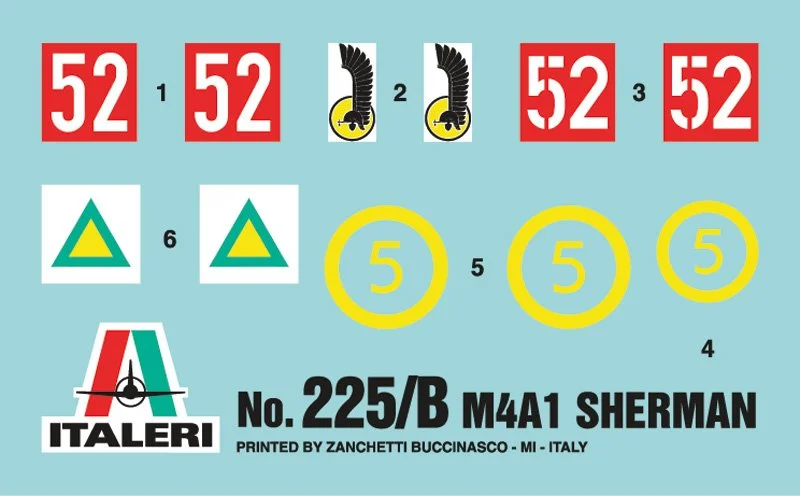
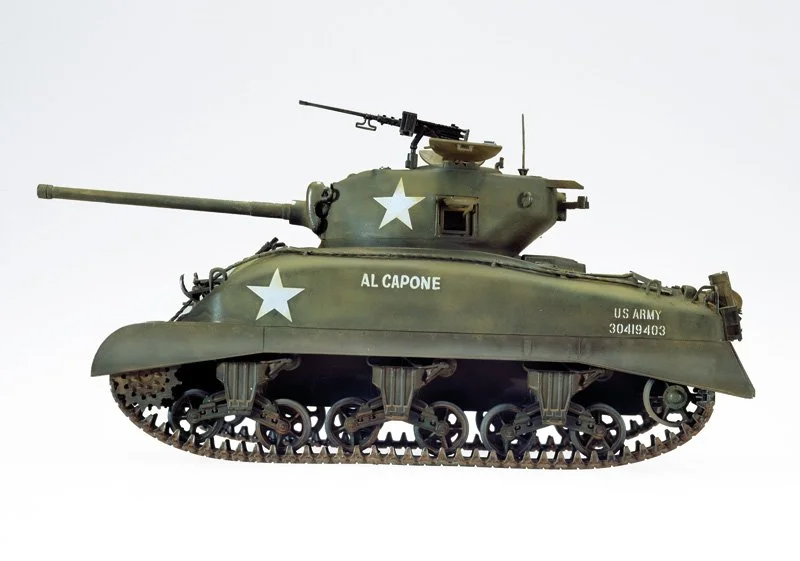
1/35 Italeri M4A1 Sherman VE-Day #225

$46.50

In 1941, after the German attack on Russia, it became clear to the UNITED STATES that possibility of an American involvement in the war was becoming more and more inevitable. For this reason, President Roosevelt ordered substantial production increases of the medium tank M4. The tank was not a completely new model, since it derived from the previous model M3 “Grant”. The Sherman had some major improvements on the superstructure and on the armament as well as on the welded or cast hull. The “General Sherman”, under which name the new tank was soon to be known, was equipped with a 75 mm gun, which was, however, insufficient against the German Tanks. This necessitated a series of changes, including a completely new turret as well as a 76 mm gun, which would be more efficient than the previous one. The new prototype was given the designation M4 A1. In January 1944, the new type was introduced. Until the end of the war, about 3400 pieces were produced. Notwithstanding the improvements, there were still many defects, one of them being the lack of protection. Frequently the crew was forced to protect the tank sides and the front with sandbags. In some instances the most exposed track sections were covered and sometimes even cement or steel blocks were attached. Tanks to its numerical superiority, the tank was able to match the German tanks, using its great maneouverability and its excellent 76 mm gun. M4 A1 took part in the invasion of Normandy and in all European theatres.

In 1941, after the German attack on Russia, it became clear to the UNITED STATES that possibility of an American involvement in the war was becoming more and more inevitable. For this reason, President Roosevelt ordered substantial production increases of the medium tank M4. The tank was not a completely new model, since it derived from the previous model M3 “Grant”. The Sherman had some major improvements on the superstructure and on the armament as well as on the welded or cast hull. The “General Sherman”, under which name the new tank was soon to be known, was equipped with a 75 mm gun, which was, however, insufficient against the German Tanks. This necessitated a series of changes, including a completely new turret as well as a 76 mm gun, which would be more efficient than the previous one. The new prototype was given the designation M4 A1. In January 1944, the new type was introduced. Until the end of the war, about 3400 pieces were produced. Notwithstanding the improvements, there were still many defects, one of them being the lack of protection. Frequently the crew was forced to protect the tank sides and the front with sandbags. In some instances the most exposed track sections were covered and sometimes even cement or steel blocks were attached. Tanks to its numerical superiority, the tank was able to match the German tanks, using its great maneouverability and its excellent 76 mm gun. M4 A1 took part in the invasion of Normandy and in all European theatres.

The M4A3E8 "Easy Eight" was a smooth-riding horizontal volute spring suspension (HVSS) variant of the Allied workhorse Sherman medium tank. It was an improved threat over predecessors thanks to a more powerful, 76mm gun, and employed a V8 gasoline engine in its welded hull. As perhaps the finest of the Sherman variants it played an important role in the eventual Allied WWII victory, but its service did not end there: When conflict flared again in June 1950, this time on the Korean peninsula, Easy Eights were refurbished and deployed again, taking on enemy T34/85 tanks operated by the Korean People's Army from the invading North, and serving till the armistice of 1953. The distinctive marking pattern shown in the main picture on this page is said to have been employed in an attempt at psychological warfare.

★This is a 1/35 scale plastic model assembly kit. Length: 215mm, width: 86mm.

★The form of a Korean War M4A3E8 is expertly captured, with renderings of the various upgrades made to the tank.

★Late production Sherman deflector and gun shield canvas cover are authentically recreated, along with updated gun travel lock and radio equipment.

★Double-pin T80 tracks are rendered accurately and fuss-free by belt-type parts. ★Separate slide mold M2 machine gun mount and barrel attachment point parts.

★Comes with commander and loader torso figures, plus 2 marking options including the "Rice's Red Devils" company of the 89th Tank Battalion.

★Parts included to create enemy field car.

*This interpretation of the "Rice's Red Devils" markings is based upon photographs and contributing research from David Doyle. (see original below)
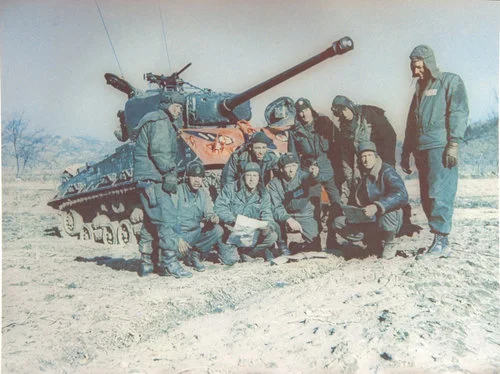
Korean War ConflictM/Sgt, Wesley W. Robinson of Blue Ridge, Ga., a member of the 89th Tank Battalion, Co. C, is giving his crew last minute instructions (6 March 1951). Source: David Doyle Books Web (https://daviddoylebooks.com/rices-red-devils/)
Korean War Conflict

M/Sgt, Wesley W. Robinson of Blue Ridge, Ga., a member of the 89th Tank Battalion, Co. C, is giving his crew last minute instructions (6 March 1951). Source: David Doyle Books Web (https://daviddoylebooks.com/rices-red-devils/)

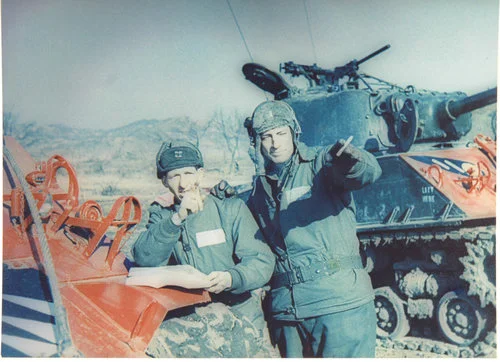
Korean WarCaptain Clarence C. Rice of Chester, Pa., (left) Commander of the 89th Tank Battalion, Co. C. and 1st Lt. Fred Wilkins of Lancing, Michigan, Assistant Commander, discussing a problem (6 March 1951)

Korean War

Captain Clarence C. Rice of Chester, Pa., (left) Commander of the 89th Tank Battalion, Co. C. and 1st Lt. Fred Wilkins of Lancing, Michigan, Assistant Commander, discussing a problem (6 March 1951)